Automotive rear combination light for visibility and safety
Delivering tail, stop and rear position lighting through LEDs with high brightness, reliability and efficiency
Rear lighting solutions for safety, visibility and modern styling
Rear and stop lights ensure vehicle visibility and fast braking recognition, while illuminated logos and rear signature elements enhance brand identity. As rear lighting becomes both a safety feature and a design element, ams OSRAM enables bright, uniform, and reliable solutions with high‑performance LEDs tailored for modern styling and regulatory compliance.
What is a rear combination lamp and what does it contain?
A rear combination lamp integrates several rear‑lighting functions into one unit. It typically includes the red rear position light (tail light) and the brake light (stop light), which may be implemented using the same lamp at different brightness levels. The lower‑brightness level provides the rear‑position function, while the higher‑brightness level ensures clear braking recognition. These brightness differences are regulated to guarantee that both functions remain easily distinguishable. In addition to the left and right rear lamps, a center high‑mounted stop lamp (CHMSL) is required in many regions, along with rear fog lamps. Distinct from these red functions are the white reversing lights, which illuminate the area behind the vehicle. For more information on suitable LEDs for reversing lights, please refer to the Daytime running light page. Another white light located at the rear is the license‑plate light, which is covered in the Car body illumination section.
Technology overview: LEDs, LED Modules, OLED and LED-on-foil
LEDs have been the primary light source for rear combination lamps for decades due to their high efficiency, reliability, fast response time, and design versatility. They are widely used for both rear position and brake functions. Some vehicle platforms employ replaceable LED modules to simplify servicing.
More recently, OLED panels have been introduced in premium models to enable uniform, flat, and visually distinctive designs. In parallel, next‑generation LED‑on‑foil technologies now allow curved and ultra‑thin lighting elements with high brightness and unique styling possibilities. For additional details, refer to the LED‑on‑Foil page.
Design aspects for rear combination lamps
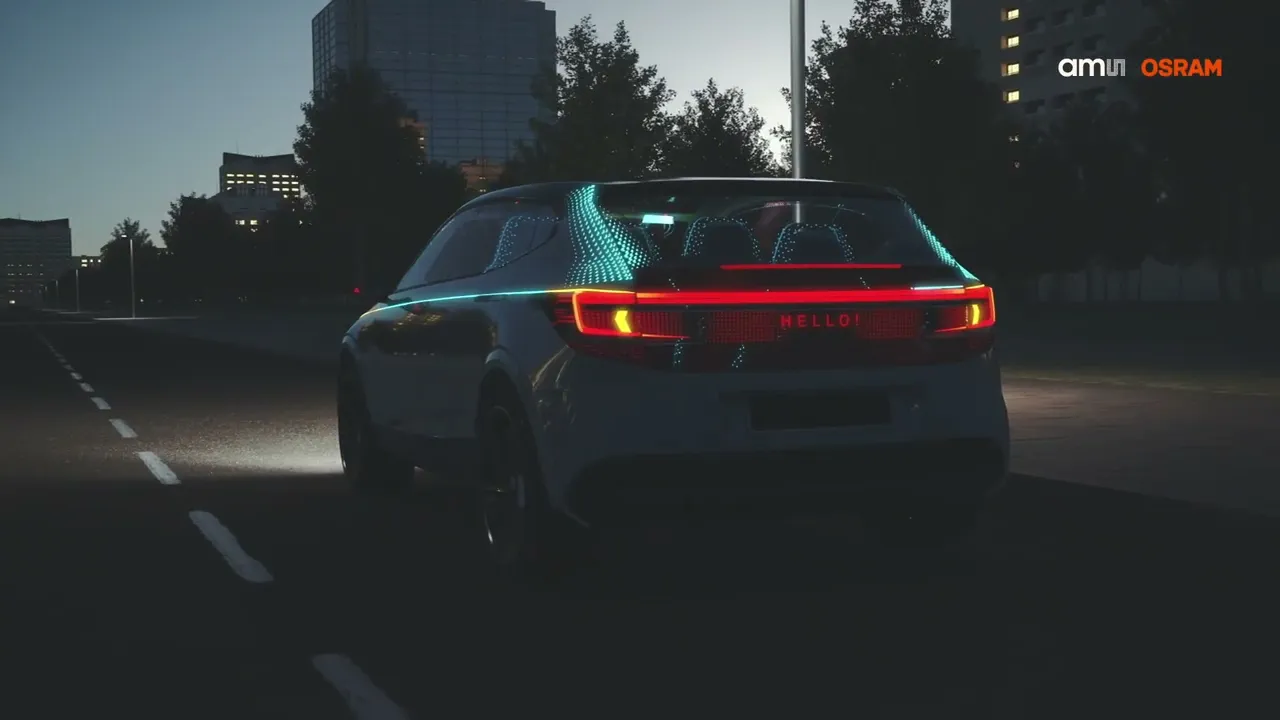
Rear combination lamps often group individual LEDs into clusters to achieve the desired light distribution and styling. In some vehicles, individual LED addressability enables dynamic lighting effects. With higher pixel densities, rear lamps can even support interactive signal displays—sometimes referred to as “interactive social displays”—which enable new forms of V2X‑related communication. These concepts are discussed in more detail in the Intelligent signal display section.
FAQ: Below are some of the most common questions about rear combination light
A rear combination lamp integrates multiple rear‑lighting functions such as tail, stop, and position lights, while a single rear light typically refers to one individual function.
LED‑on‑foil offers similar design flexibility to OLED, but with the brightness, robustness, and long lifetime of LED technology.
Featured Products

OSRAM SYNIOS™ S2222, KR DDLM31.23
OSRAM SYNIOS™ P2720, KR DMLQ31.FR
OSRAM SYNIOS™ P2720, KR DMLQ32.23
OSRAM SYNIOS™ P1515, KR SITQA1.23